
Choosing Solar Panel Types: Monocrystalline vs. Polycrystalline vs. Thin-Film
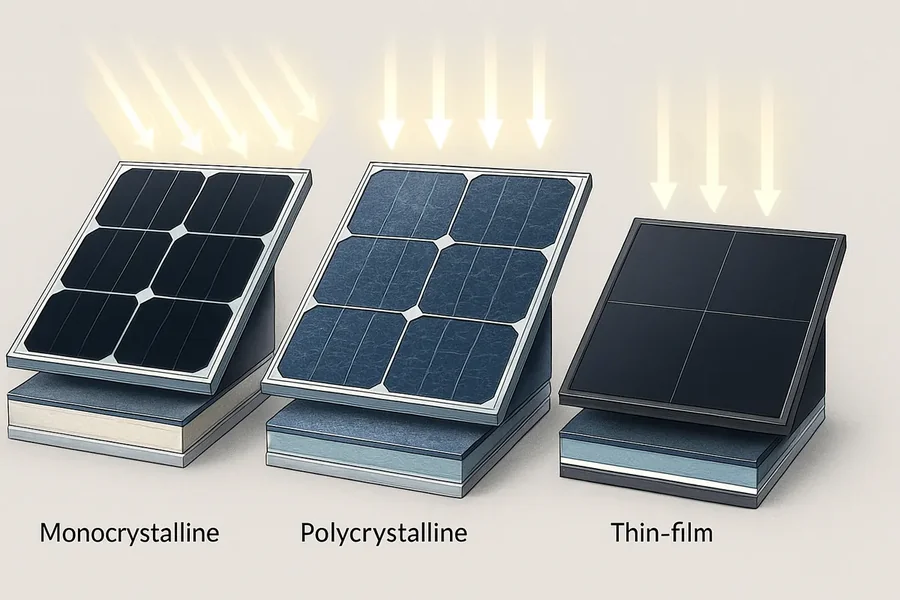
Solar panels can look similar from a distance, but the technology inside them changes how they perform in real homes and businesses. The panel type affects efficiency, space requirements, appearance, heat behavior, and how the system holds output over time. Many buyers start with one goal—lower electricity bills—but quickly realize they must balance roof size, shading, budget, and local weather. Monocrystalline, polycrystalline, and thin-film panels each have strengths that fit certain situations better than others. Understanding the differences helps you avoid paying for capabilities you won’t use or choosing a low-cost option that doesn’t match your site conditions. A thoughtful choice can make installation smoother and keep your expected production closer to reality.
Comparing Options With Real-World Priorities
1.What Panel Type Really Means for Your System
The “type” of solar panel refers to the photovoltaic material and its manufacturing process, which directly influence how efficiently it converts sunlight into electricity. Monocrystalline panels are made from single-crystal silicon, polycrystalline panels use multiple silicon crystals fused together, and thin-film panels use very thin layers of photovoltaic material deposited on a surface. These differences show up in efficiency ratings, temperature response, and physical design. Higher efficiency matters most when roof space is limited because you can produce more power with fewer panels. Lower efficiency can still work well when space is plentiful, the budget is tight, or the system is designed to cover only a portion of usage. Panel type also influences how the array looks, how heavy it is, and how it responds to partial shade. Choosing properly is not about chasing a label; it’s about matching the panel’s behavior to your roof layout, sun hours, and year-round performance expectations.
2. Monocrystalline: High Output in Limited Space
Monocrystalline panels are often chosen when the goal is strong production from a smaller roof area. Because silicon is more uniform, these panels typically achieve higher efficiency, which can be valuable for homes with limited south-facing space or many roof obstructions, such as vents and skylights. Their appearance is usually darker and more uniform, which some homeowners prefer for curb appeal. Another practical factor is that a higher-efficiency array may reduce the number of panels required, simplifying layout and sometimes leaving room for future expansion. That said, monocrystalline panels can cost more, and the value depends on how constrained your site is. If you have ample open roof area, the premium may not translate into a meaningful production advantage compared with other options. Many solar installers will also consider the inverter choice and panel placement together, because the gains from higher efficiency can be reduced if shading and roof orientation are not addressed.
3. Polycrystalline: Balanced Cost and Practical Performance
Polycrystalline panels can offer a cost-friendly way to build a solid solar array, especially when roof space is not extremely tight. Their manufacturing process typically uses less refined silicon, which often results in slightly lower efficiency compared with monocrystalline. In practical terms, that can mean you need a bit more roof area to reach the same system size in kilowatts. However, many properties have enough usable space that this tradeoff is acceptable. Polycrystalline panels may appear bluish and more speckled due to their multiple crystal structure, which is mostly an aesthetic consideration. Performance differences can become more noticeable when the roof is small, when you want to maximize production for net metering, or when local electricity rates make every extra kilowatt-hour valuable. Still, polycrystalline remains a workable option for homeowners who want reliable generation without prioritizing the smallest possible footprint. The key is to confirm that your roof can accommodate the extra panel count needed to meet your energy target.
4. Thin-Film: Flexibility, Weight, and Different Use Cases
Thin-film panels represent a different approach to solar, and their advantages often show up in non-traditional installations. Because thin-film modules can be lighter and sometimes more flexible, they may be used on large commercial roofs, curved surfaces, or structures where weight and mounting constraints matter. Thin-film technology can also perform relatively well at high temperatures and in certain low-light conditions, though typical efficiency is lower than that of crystalline silicon options. Lower efficiency means more surface area is required for the same power output, so thin-film is often less practical for small residential roofs unless there is abundant space. Another consideration is lifespan and degradation characteristics, which vary by thin-film material and manufacturer. In some projects, thin-film fits because the roof is vast and the installation is designed around covering a wide area rather than concentrating output per square meter. For homeowners, thin-film can still be worth considering when roof loading is a concern, when aesthetics require a low-profile design, or when site conditions reduce the value of high-efficiency panels.
5. Heat, Shade, and Why Efficiency Isn’t the Only Metric
Efficiency numbers are easy to compare, but daily production depends on conditions that efficiency labels do not fully capture. Heat is one of the most overlooked factors. Panels tend to produce less power as they get hotter, and this temperature behavior is described by a temperature coefficient. Two panels with similar efficiency can perform differently on a scorching roof if one handles heat better. Shade is another major factor. Even small shade from a tree branch, a parapet wall, or a nearby building can reduce output disproportionately if the array is not designed to manage it. Panel type matters, but so does system design, including panel stringing and the use of module-level electronics like microinverters or optimizers. In addition, roof orientation and tilt often influence annual yield more than the difference between monocrystalline and polycrystalline. A slightly lower-efficiency panel in a better location can outperform a higher-efficiency panel in a location with limited sun exposure. Considering these conditions prevents disappointment when real production doesn’t match a simple efficiency comparison.
6. Durability, Degradation, and Long-Term Value
Solar panels are long-term assets, so it helps to look beyond first-year output. Most panels slowly produce less energy over time, a process known as degradation. The warranty typically includes both a product warranty and a performance warranty, and the terms can differ by manufacturer and panel category. While monocrystalline panels are often associated with strong long-term performance, real durability depends heavily on build quality, encapsulation, frame design, and quality control rather than the crystal structure alone. Polycrystalline panels from reputable manufacturers can still maintain steady output when installed properly. Thin-film panels have varied degradation behavior depending on the technology used, and some types have improved significantly over the years. For any panel type, long-term value also depends on how well the system is mounted and maintained, whether wiring is protected from weather exposure, and whether the roof itself will remain in good condition for the panel’s lifespan. Evaluating warranties, manufacturer track record, and local support can be just as important as choosing between mono, poly, and thin-film.
7. A Simple Way to Match Panel Type to Your Roof
The most practical approach is to start with your roof’s constraints and your energy target, then work backward to the panel type that fits. If roof space is limited, monocrystalline panels may allow you to reach your desired system size without overcrowding the layout. If space is adequate and budget sensitivity is high, polycrystalline may deliver the needed capacity at a more approachable cost, provided the roof can support the panel count. If the installation surface is unusual, weight-restricted, or very large, thin-film might be worth considering, especially in commercial contexts. This paragraph is intentionally shorter to emphasize that decision-making becomes clearer when you focus on site limitations rather than getting stuck in spec comparisons. A good quote should include a layout drawing, estimated annual production, and assumptions about shading and orientation. When those details are transparent, the panel type decision becomes less intimidating and more aligned with real output expectations.
Choosing between monocrystalline, polycrystalline, and thin-film panels is less about picking a “premium” label and more about matching technology to your site. Monocrystalline panels can make sense when roof space is tight or when you want more power from fewer modules. Polycrystalline panels can work well when you have adequate space and want a straightforward system that meets energy goals without paying extra for compactness. Thin-film panels can fit certain roofs and structures where weight, flexibility, or large surface area shapes the design, though they often require more area for the same output. Beyond panel type, real performance depends on roof orientation, shading, temperature, and system design choices like inverters and wiring. Looking at warranties, degradation expectations, and installation quality helps protect long-term value. With clear production estimates and an honest assessment of your roof, you can choose a panel type that supports consistent generation for years.